Betty Boop Cartoons in Public Domain!
All cartoons are available in Mpeg2 and Mpeg4 digital file format. On Jan. 1, 2027 all Betty Boop cartoons made in 1931 will fall into public domain. Here are three of her very first cartoons from 1930:
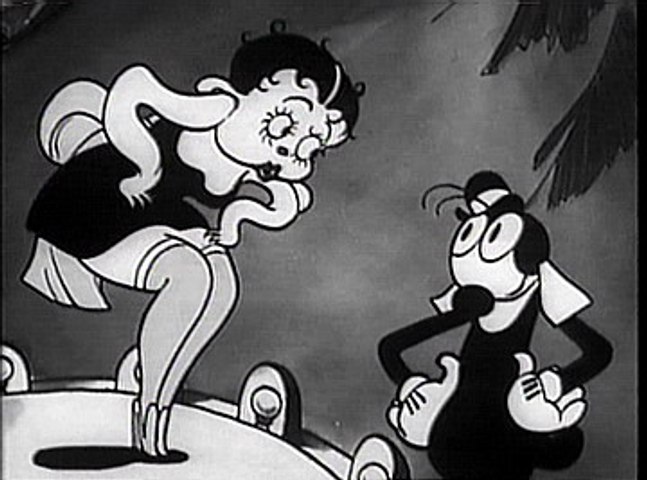
Dizzy Dishes (1930) 6m. Betty Boop (with dog's ears) is an entertainer in a restaurant for dogs. Bimbo the Pup is a waiter who neglects patrons to interact with Betty. Part of a 42-cartoon series 'Talkartoons' that augmented Fleischer Studio's earlier "Screen Songs" series, which in turn morphed from the even earlier 'Ko-Ko the Clown" silent cartoons.
Barnacle Bill (1930) Sailor Bimbo (as Barnacle Bill) jumps ship with his little black book and visits his lady friend, Betty Boop (with dog's ears).
Mysterious Mose (1930) Betty Boop (still with dog's ears) can't sleep on a scary night, so she sings the title song and meets the gentleman in question... a surreal version of Bimbo.
50+ Boops also available:
Baby Be Good (1935) Betty Boop tells naughty Little Jimmy a corrective fairy tale (with herself as fairy).
Betty Boop & Grampy (1935) Two piano movers, a fireman and a traffic cop all drop what they're doing to join Betty Boop at the contraption-happy Grampy's eccentric party.
Betty Boop & Little Jimmy (1936) Betty tries a regime of exercise, but her weight loss gets out of hand. She sings "Keep Your Girlish Figure."
Betty Boop & Little King (1936) The Little King, a comic strip character from the newspapers, meets Betty Boop.
Betty Boop with Henry (1935) Henry, another newspaper comic strip character, gets a job at Betty Boop's pet store.
Betty Boop's Crazy Inventions (1933) In a circus tent, Betty, Bimbo and Koko demonstrate some gadgets reminiscent of TV ads; an animated sewing machine gets out of hand.
Betty Boop's Ker-Choo (1933) Betty, Koko, and Bimbo drive at the auto races; Betty has a cold, and her sneezes help her win.
Betty Boop's Rise to Fame (1934) A reporter interviews Max Fleischer about his creation, and Betty comes Out of the Inkwell to illustrate with excerpts from three prior cartoons.
Be Human (1936) Betty Boop is incensed at her farmer neighbor's cruelty to his animals. But the inventive Grampy knows how to teach him a lesson.
Betty in Blunderland (1934) Betty falls asleep doing a jigsaw puzzle of Alice in Wonderland. She dreams she is Alice and follows the white rabbit through the looking glass.
Buzzy Boop (rare) (1938) Buzzy Boop, Betty Boop's tomboyish young cousin, Buzzy, takes the train to visit Betty.
Candid Candidate (1937) Betty Boop campaigns for Grampy for Mayor, and wins by one vote
Ding Dong Doggie (1937) Against Betty Boop's orders (and to his own discomfiture), Pudgy the Pup accompanies a dalmatian fire dog to a fire.
Dizzy Dishes (1930) Betty Boop, in first cartoon ever, is an entertainer in a restaurant for dogs. Bimbo neglects patrons to join the floor show.
Grampy-Christmas Comes But Once A Year (1936) At an orphanage, the children are sad because they received broken toys as gifts. Professor Grampy sees the children while passing by in his sled and has an idea on how to give them a merry Christmas.
Grampy's Indoor Outing (1936) Betty Boop and Little Jimmy are prevented by a thunderstorm from going to the carnival; the inventive Grampy devises a substitute.
Happy You and Merry me (1936) A stray kitten wanders into Betty Boop's house, gets sick on candy, and is cured with catnip by Betty and Pudgy the pup.
Hot Air Salesman (1937) A door to door salesman visits Betty Boop's home with a long line of useless household gadgets.
House Cleaning Blues (1937) Housecleaning blues are just what Betty Boop has the morning after a wild party. Grampy to the rescue!
Impractical Joker (1937) Betty Boop is baking a cake, when Irving the practical joker comes for a visit. Betty calls on Grampy for help.
Is My Palm Read (1933) For customer Betty Boop, psychic reader Prof. Bimbo conjures up an adventure on a haunted tropical island in his crystal ball.
Judge for Day (1935) Betty Boop, annoyed by 'public pests' like backslappers, gum parkers, and mud splashers, imagines what she'd do to them if she were a judge.
Language All My Own (1935) Betty Boop takes her stage act on the road, and plays in Japan to great acclaim.
Little Nobody (1936) Betty Boop's cute dog Pudgy wants to date a girl dog but her owner is snooty and shoos him away. A heartbroken Pudgy soon proves that he's not a nobody.
Little Soap and Water (1935) Betty Boop tries to give Pudgy the Pup a bath, with slapstick results.
Making Friends (1936) Pudgy the pup takes Betty Boop's advice ('Go Out and Make Friends With the World') to heart and befriends various wild animals.
Making Stars (1935) Betty Boop emcees a stage show presenting "future stars"...performing infants (including racial stereotypes).
More Pep (1936) In a return to the 'Out of the Inkwell' format, Betty Boop invents a 'pep' formula to speed up lazy Pudgy, but it escapes into the 'real world' with rapid results.
Musical Mountaineers (1936) Betty Boop runs out of gas in Feud County, and wins over the initially hostile hillbillies with her dancing.
My Friend the Monkey (1939) A swingin' hurdy-gurdy man goes by Betty Boop's house; she wants to buy the monkey, which causes plenty of trouble for Pudgy the Pup.
No! No! A Thousand Times No (1935) Betty Boop and Freddie appear on stage in a melodrama, wherein Betty sings the title song to the villain.
Not Now (1936) A noisy cat is preventing Betty Boop from getting any sleep at night. Pudgy tries to chase the cat away.
On With the New (1938) Betty Boop quits her job as overworked short-order cook to run an automated baby-care center. Will she regret it?
Poor Cinderella (1934) (1934) In her only color cartoon, Betty Boop goes to the ball thanks to her fairy godmother; later, only her foot fits the glass slipper.
Pudgy and Lost Kitten (1938) Myron the kitten and his mother, from a previous Betty Boop cartoon called Happy You and Merry Me make a return appearance.
Pudgy Picks a Fight (1937) Betty Boop is so delighted with her new fox fur that Pudgy the Pup grows jealous, then thinks he's killed it...
Pudgy Takes a Bow Wow (1937) Betty Boop's stage show takes a new turn when Pudgy the pup and his feline enemy get into the act.
Rhythm on Reservation (1937) Betty Boop's Swing Band (sans musicians) visits an Indian reservation where Betty teaches the braves the true meaning of 'rhythm.'
Scared Crows (1939) Betty Boop and Pudgy, doing the spring planting, are plagued by crows.
So Does an Automobile (1939) At Betty Boop's Auto Hospital, the cars are treated for various humanlike ailments.
Song a Day (1936) At Betty Boop's Animal Hospital, various species have appropriate ailments. Morale becomes a problem; Professor Grampy to the rescue!
Stop That Noise (1935) To escape her noisy city apartment, Betty Boop retreats to her country home, but the insects are against her.
Swat the Fly (1935) While Betty Boop tries to cook, a fly drives her and Pudgy the Pup to distraction.
Taking the Blame (1935) Betty Boop brings home a cat as playmate for Pudgy, but the cat is a bully who only gets Pudgy into trouble.
Training Pigeons (1936) Betty Boop is training a flock of pigeons, but one stray leads Pudgy the pup on a precarious chase over the rooftops.
We Did it (1936) While Betty Boop is away, the kittens get into mischief. Will Pudgy the Pup take the blame as usual?
Whoops, I'm a Cowboy (1937) Betty Boop's runt of a suitor thinks he'll have better luck if he takes cowboy lessons at a dude ranch; slapstick results.
You're Not Built That Way (1936) Pudgy the pup tries to emulate a tough bulldog, but Betty Boop sings him the error of his ways.